
or why Haier may be the new Toyota
How people organize their work is, in fact, a long history with thousands of dots representing a small improvement. And it is rather a network than a straight line. People failed, learned, and improved what we today call the management.
Although the boundaries of management principles are blurred, and there were no overnight breakthroughs, some of these historical management changes stand out as something that deserves to be called a revolution.
The Toyota Way
For over a decade, my Business Agility classes started with a story of how Toyota practically smashed the US car industry during the ‘80s and ‘90s. People listen to it with their eyes wide open because this fairy-tale-style sticks to their memory. But the interesting difference compared to the fairy tale is that this story is all true.
Even though that new way of working was developing in Japan after WWII, the Western world learned about it in a very hard way in the early ’80s. As a consequence of then new Toyota management style, Detroit, once a proud capital of the big three (Ford, GM, and Chrysler), became a synonym for the abandoned factories and population decrease. Conversely, in only 20 years, Toyota jumped from being an outsider to the biggest car producer in the World.
Japanese don’t have a name for this way of working, but Americans named it Lean, or Toyota Production System (TPS) as it is officially called today.
Since this article is not about Lean, let’s just name a few principles and practices introduced back then: People empowerment, waste reduction, continuous improvement (Kaizen),… It spread all around the Globe like fire, and it is still relevant as before.
Age of Agile
Heavily influenced by Lean, a group of influential people from software development started the Agile movement in the early ’00s. I’m one of those guys who consider Lean and Agile to be two fingers of the same hand. Some principles like People empowerment and continuous improvement are practically the same as in Lean. Still, the Agile way of working popularized some new principles like early delivery and business flexibility.
Although the focus moved from individual teams to organizations, the principles of business agility stayed the same. Because business uncertainty is growing, Agile principles are even more relevant today than before.
The new philosophy on the horizon — RenDanHeYi
Occasionally, a story about some unusual, extremely successful management concept hits the Internet — for example, Huurtzorg or bossless Valve. These stories are inspirational but still not strong enough to roll the new ball. But a big contender is on the horizon.
Haier is a company with a 230 bn revenue and 110K employees (2021). They swiftly became the leading producer of white goods by managing the company in a totally different way. As the World looked at Toyota 40 years ago, now it is the time to turn our heads to the East again — this time to China.
They call their way of work RenDanHeYi. A very loose translation would be “the more client value you generate — the more value you receive.”
RenDanHeYi borrowed a lot of principles from Lean and Agile and scaled it to an enormous extent.
Radical decentralization
During 30 years of evolution, Haier transformed into a network of Micro Enterprises (ME). Each ME is like a small company with high autonomy. They have their profit and loss statement to manage their budget in a way that best works for them. They don’t need approval to hire, fire, invest, or whatever makes sense.
From the organizational point of view, MEs have the freedom to organize internally however they want. Whether they be a single-boss squad or led by 100 people, it’s completely up to them.
Typically, there are two types of MEs: Customer-facing and Supporting.
Customer-facing MEs are those producing or servicing end-users. They nurture zero distance to customer culture. This philosophy is deeply planted into Haier’s DNA because it is the only way to do what customers really need. As a consequence, a profit is generated for the ME and for the Haier as a whole.
Such ME could be as small as a single store in a rural area or as big as a specialized delivery service with hundreds of trucks.
Supporting MEs business is oriented to other MEs. Basically, other MEs are their customers. This could be a bunch of designers, financial experts, or platform app developers.
Today, Haier has more than 4000 such MEs.
Internal market
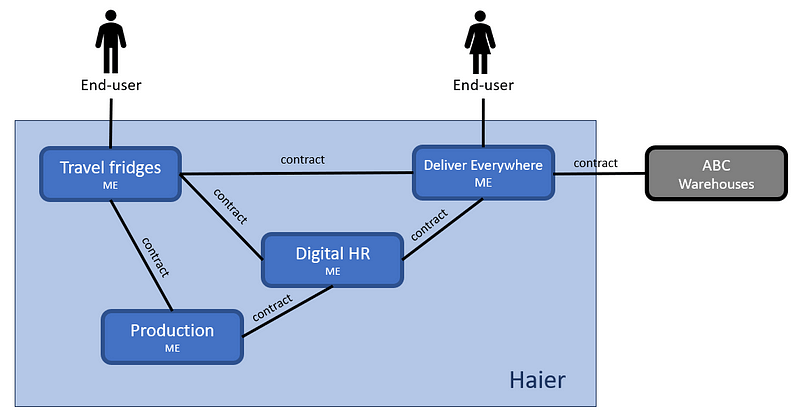
MEs are networked on contractual rather than hierarchical principles. They use an internal platform to sign contracts and bill each other.
Literally, everything is based on contracts between MEs. Even the offices are rented from Facility Management ME.
Since Haier wanted MEs to be fully confident in a system that manages contracts, it is built on blockchain technology. Blockchain technology works in a way that information is decentralized and immutable. There is always a history of all events.
The Haier’s internal market is highly competitive. For example, it is common to see that some MEs take other MEs’ customers and cause the less successful ones to cease to exist.
Also, the market is not restricted to Haier MEs. If some ME find a better partner outside Haier, they are free to establish a partnership with them.
Ecosystems
When Haier realized that ME-to-ME profit-sharing contracting could lead to unhealthy internal competition, Haier introduced EMCs (Ecosystem Micro-Community).
EMC is a project-based contract that gathers multiple MEs together. The main part of this contract is a profit-sharing scheme defining how eventual profit is shared between the MEs. It means that all MEs have to wait for the product or services to be paid to receive their share.
EMC can, and usually does, include external partners. Also, one ME can belong to multiple EMSs.
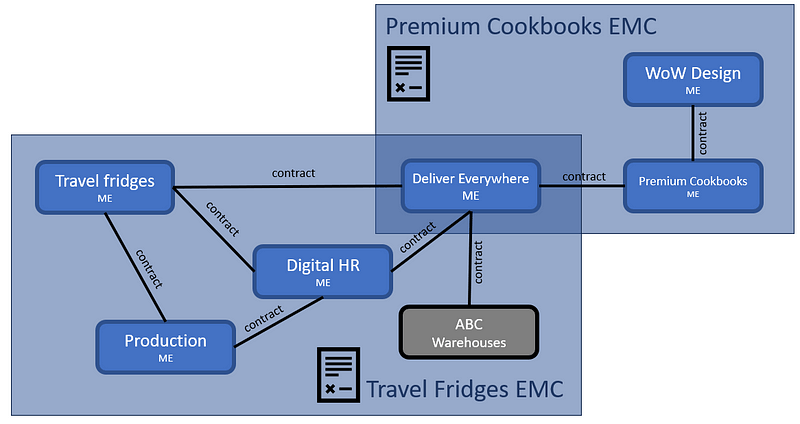
The main benefit of having the EMCs is that MEs cannot just look at their own interest but have to focus on the Customer.
Evolution of MEs
Like a real company, MEs have growth as their goal, too.
In Haier, a permanent group of related MEs is called a platform. Make sure to distinguish it from EMCs. Platforms are formal, permanent structures, while EMCs are temporary, project-based, and dynamic.
Platforms do not manage the containing MEs (they’re autonomous) but remove the obstacles (for example, by investing in a common software) or direct them towards the goals (for example, by providing the resources for strategic initiatives).
So, if some ME is successful, it is common to see it become a platform, thus switching from doing the work to facilitating it.
The story sometimes goes even further so that a platform becomes an independent legal entity. One such example is RRS Logistics.
Everyone is an entrepreneur
Who can start a ME? Any employee or a group of employees!
You have to prepare and pitch your idea in front of the Platform committee. If they like it, they approve this ME forming and possibly invest some resources or money in it. An initial agreement with the platform may include some funding, but it doesn’t have to. For example, it is common to ask the ME to find some external sourcing.
On a personal level, when joining the ME, your income directly depends on how your client or your peers see your contribution. So, some employees who started a successful ME became millionaires.
How entrepreneurial is that?
Openness
Haier tries to remove the boundaries with other companies. We already mentioned that some MEs were asked to look for external funding. One such example was the Hello Kitty washing machine. But it doesn’t stop with funding. MEs frequently seek people, resources, and ideas outside of Haier, and everybody is totally OK with it.
To establish a better connection with external partners, in 2009, Haier formed a super successful open innovation service platform HOPE. Today, it is a huge community of 200,000+ experts ready to contribute to published issues. Haier uses this platform a lot to receive needed expertise or even to recruit.
What’s the point?
Haier is, basically, a start-up factory, which is also the name of a very good book describing the RenDanHeYi model. The proof that this model works good is the 49% success rate of Haier MEs compared to a Chinese start-up success rate of 10%.
The model itself and the buzzword(s) around it receive a lot of attention in these days. As with any brilliant but complex implementation, it cannot be simply copied to your company. But it can spark your imagination and motivate you to find your own way.
So, the real question is: “What’s in it for you?”




 Business Agility in the Age of AI
Leave a comment