
It’s 9 am and John has just started his workday. His laptop was in sleep mode, so it started exactly where he stopped yesterday. A mail notification shows 15 unread messages that came through during the night.
His browser has 6 tabs open. John clicks the tabs in sequence only to remind himself of his tasks in progress. Once he reaches the final tab, an unpleasant feeling passes over him that he’s completely forgotten the first tab’s content.
An ERP application is open as well, but looking at this is unpleasant too, because John cannot recall why exactly it’s on that specific filtered list…?
Ok, ok,… After a quick sip of coffee, John decides to start analyzing the report opened in his browser because he knows it’s an absolute priority to Mary. Of course, he starts from the beginning, although he did the same thing yesterday.
Beep!
An e-mail notification catches John’s attention. It’s from his colleague and he’ll check it later.
Beep!
This time it’s from his boss. John immediately clicks on the notification and opens the message. Yet another urgent task. And it’s completely new, so John opens a new tab to check this new client opportunity. He decides to give it a quick look — just enough to answer at least something to his boss. After sending it, he’ll get back to that report from yesterday.
Sounds familiar? If not, you can leave now. Otherwise — keep reading!
A good employee can multitask. Right?
Let’s see what is happening here:
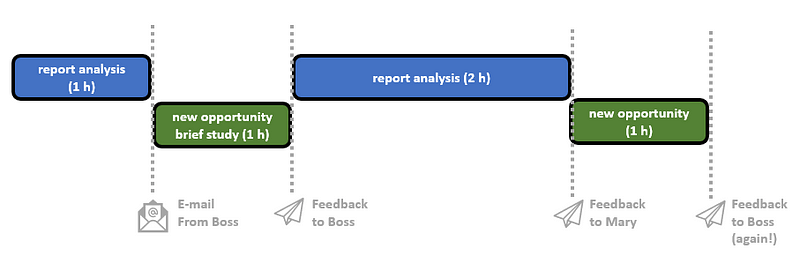
John started the report analysis because it was a top priority for Mary. But after only an hour, he received a new urgent task to check an opportunity for a client. He immediately jumped on it but only partially did the work so he could send some feedback to his boss. John immediately jumped on it and partially did his work, just to send some feedback to his Boss.
Once he finished that, he returned to his task for Mary and spent two hours on it. Sent feedback to Mary. Done.
Then he continued to work on the unfinished task for his boss for another hour. He found some issues with his previous feedback, so he edited it and sent another version to his boss. Done.
Now take a look at picture 1 again. Does John really do two tasks in parallel? No. He has to stop working on one task to start working on another. This may seem too obvious, but it’s very important. This is because the human brain cannot do more than one creative task at a time. So, it is fair to say that real multi-tasking for humans does not exist.
Here’s what John really does when “multi-tasking”
In reality, John is assigning a small portion of his working time to the parts of the tasks. We can call it a “time-sharing” approach.
But there is also a hidden consequence of it. Take a look at this picture:
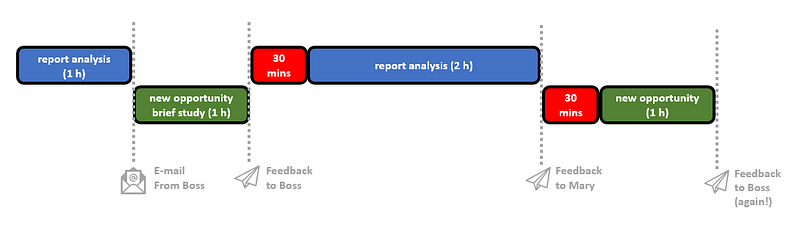
Notice the red parts. I’m sure that you’re experienced enough to agree that switching from one complex task to another is not easy. It often means that you have to spend some time reminding yourself about the things that you already did. It is the same with John, so he spends an additional 30 minutes reminding himself of his previous findings on the topic.
Notice that John has to spend this extra time only because he is pretending to multi-task. In Lean thinking, it is known as the Waste. The Waste is what you do that is not necessary to accomplish the goal. In our case, we can say that it’s the “cost” of context switching.
Stop starting start finishing
Now, let’s do some simple math. Look at picture 2 again and figure out:
- How long did Mary wait for the report analysis? — the feedback was sent to her after 4 hours and 30 mins
- How long did John’s boss wait for the new opportunity analysis? — the first feedback was sent after an hour, but since John’s analysis was incomplete, it was faulty. The complete and accurate feedback was sent 5 hours after John received the task.
- How much time did John spend in total until he finished those two tasks? — 6 hours
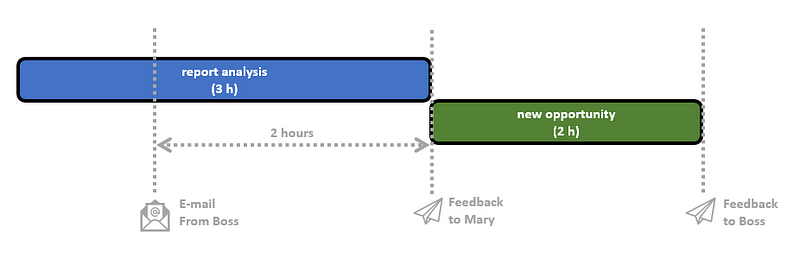
Now suppose that John does not pretend that he is able to work in multitasking mode. In this case, his work would look like this:
Let’s calculate the same things:
- How long did Mary wait for the report analysis? — the feedback was sent to her after 3 hours
- How long did his boss wait for the new opportunity analysis? — the feedback was sent to his boss after 4 hours, without faulty intermediate feedback!
- How much time did John spend in total on those two tasks? — 5 hours
Now compare these numbers with the previous case. It is clear that “multi-tasking” is bringing the Waste into your workday. As a result, people wait longer for you to deliver.
Imagine what happens in a more realistic case when John works “in parallel” on five or more tasks!
Although sometimes it might make sense to temporarily stop working on a task while you wait for something, in general, that’s not optimal. You should always try to finish the task before you start with another. That makes you faster!
It’s a group disease
John is a member of three teams. His boss told him that he should allocate 30% of his time to the Operations team, 30% to the Partners team, and 40% to the Sales team. It’s a similar situation with Mary and Bob from his department, but with a different percentage. Sounds familiar?
Now you probably can guess what is happening:
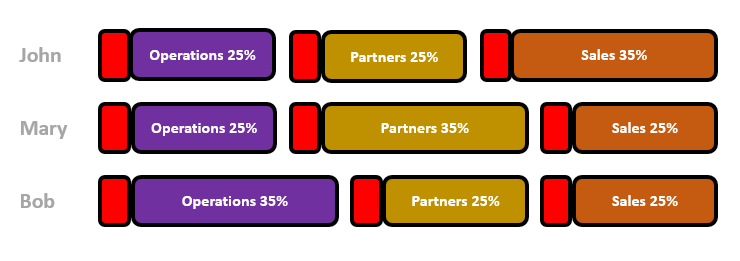
Because of his time-sharing with multiple teams, John generates the Waste. This makes him unable to fulfill his 30%-30%-40% commitment. Think about context switching and a partially done job. It is the same for Mary and Bob.
We can argue about what is the percentage of Waste, but it is always present in such cases. The more you spread people’s engagement across teams and activities — the more Waste is generated.
If you want your teams to deliver faster, don’t spread their members across multiple teams. Sometimes you really need to establish some “shared services”, but you should do it very carefully.
Why you should care?
John wants to be a true professional in his job, so he switches to a “Stop starting start finishing” model. You should do the same only if you care to be a real professional.
Next time when you see “a million” open apps on your desktop, remember what you have learned today.
Keep in mind that this principle is a life skill. It doesn’t apply only to your work, but also to your personal life. It can make you a better professional and make your life easier.
Try the following
Remove the “multi-tasking” from your work as much as it makes sense. We cannot remove it entirely, but a 100% goal is the only one that makes sense.
Customize your notification settings so they only pop up for urgent things.
Focus.






 Business Agility in the Age of AI
Leave a comment